
Quadratic Functions Worksheet with Answers PDF: A Comprehensive Plan
Jagran Josh provides NCERT-based practice worksheets for Class 11 Maths, focusing on quadratic functions. Effective problem-solving requires consistent practice, and these PDF resources deliver!
Quadratic functions are fundamental to algebra, describing relationships where a variable is squared. These functions aren’t just abstract concepts; they model real-world scenarios like projectile motion, area calculations, and optimization problems. Understanding them is crucial for success in higher-level mathematics and various scientific fields.
A quadratic function generally takes the form f(x) = ax² + bx + c, where ‘a’, ‘b’, and ‘c’ are constants, and ‘a’ is not equal to zero. The graph of a quadratic function is a U-shaped curve called a parabola.
Worksheets focusing on quadratic functions, often available as PDF downloads, are invaluable tools for students. They provide structured practice in identifying these functions, understanding their properties, and solving related equations. Resources like those offered by Jagran Josh, aligned with NCERT standards, emphasize the importance of consistent practice for mastering these skills. These worksheets help build a strong foundation for tackling more complex mathematical challenges.
Standard Form of a Quadratic Function

The standard form of a quadratic function is f(x) = ax² + bx + c. This representation is key to quickly identifying the coefficients ‘a’, ‘b’, and ‘c’, which dictate the parabola’s characteristics. ‘a’ determines the parabola’s direction and width, ‘b’ influences its position, and ‘c’ represents the y-intercept.
Worksheets centered around the standard form often require students to rewrite functions into this format, identify the coefficients, and predict the parabola’s basic shape. PDF resources, like those provided by Jagran Josh for Class 11 Maths (based on NCERT), offer targeted practice in these skills.
Mastering the standard form is essential because it serves as a starting point for various operations, including finding the vertex, axis of symmetry, and x-intercepts. Consistent practice with worksheets ensures students can confidently manipulate and interpret quadratic functions in this fundamental form, building a solid algebraic foundation.
Vertex Form of a Quadratic Function
The vertex form of a quadratic function is expressed as f(x) = a(x ⏤ h)² + k, where (h, k) directly reveals the coordinates of the parabola’s vertex. This form is particularly useful for understanding the function’s minimum or maximum value and its shifts.
Quadratic functions worksheet practice, often available as PDF downloads – such as those offered by Jagran Josh aligned with NCERT for Class 11 Maths – frequently involves converting functions from standard form to vertex form through the process of completing the square.
Worksheets also test the ability to interpret ‘a’, ‘h’, and ‘k’ to determine the vertex, axis of symmetry, and direction of opening. Understanding the vertex form allows for quick identification of key features without extensive calculations, streamlining graph analysis and problem-solving. Consistent practice builds fluency in manipulating and applying this powerful form.
Intercept Form of a Quadratic Function
The intercept form of a quadratic function is represented as f(x) = a(x ‒ r₁)(x ⏤ r₂), where r₁ and r₂ are the x-intercepts, or roots, of the parabola. This form immediately reveals where the parabola crosses the x-axis.
Quadratic functions worksheets, often found as PDF resources – like those provided by Jagran Josh for Class 11 Maths based on NCERT curriculum – emphasize identifying the roots from the equation and using them to construct the function in intercept form.
Worksheet exercises commonly involve finding the x-intercepts given the equation, or conversely, determining the equation given the roots. This form is especially helpful when solving for the zeros of the function. Mastering the intercept form enhances understanding of the relationship between the function’s equation and its graphical representation, aiding in efficient problem-solving.
Identifying Key Features: a, b, and c
In the standard form of a quadratic function, f(x) = ax² + bx + c, the coefficients a, b, and c hold crucial information about the parabola. Understanding their roles is fundamental to analyzing and graphing these functions.
Quadratic functions worksheets, frequently available as PDF downloads – such as those offered by Jagran Josh for Class 11 Maths aligned with the NCERT syllabus – heavily focus on recognizing these coefficients. Exercises often require students to identify a, b, and c from given equations.
These worksheets also explore how these values influence the parabola’s shape, direction, and position. For example, the sign of ‘a’ dictates whether the parabola opens upwards or downwards. Consistent practice, as encouraged by these resources, builds a strong foundation for more complex quadratic concepts and problem-solving skills.
The Role of ‘a’ in Determining Parabola Direction
The coefficient ‘a’ in the standard form quadratic function, f(x) = ax² + bx + c, is paramount in determining the parabola’s orientation. A positive value of ‘a’ signifies that the parabola opens upwards, creating a ‘U’ shape. Conversely, a negative ‘a’ value results in a parabola opening downwards, forming an inverted ‘U’.
Quadratic functions worksheets, often found as PDF resources – like those provided by Jagran Josh for NCERT-based Class 11 Maths practice – dedicate significant attention to this concept. Exercises commonly ask students to predict the parabola’s direction solely based on the sign of ‘a’.

These worksheets reinforce understanding through varied problems, ensuring students can confidently interpret the impact of ‘a’ on the graph. Mastering this foundational element is crucial for successfully analyzing and manipulating quadratic functions, and for effective problem-solving.
Finding the Vertex of a Parabola
The vertex represents the highest or lowest point on a parabola, a critical feature in understanding quadratic functions. Identifying the vertex is a key skill emphasized in quadratic functions worksheets, often available as PDF downloads for practice.

NCERT-based resources, such as those offered by Jagran Josh for Class 11 Maths, provide exercises focused on locating the vertex using various methods. These include completing the square, and utilizing the vertex formula. Worksheet problems frequently present quadratic equations in standard form (ax² + bx + c) and ask students to determine the vertex coordinates.
Understanding the vertex is essential for graphing parabolas and solving optimization problems. Worksheets with answer keys allow students to self-assess and reinforce their understanding of this fundamental concept, building a strong foundation in quadratic analysis.
Vertex Formula Derivation
Deriving the vertex formula is a crucial step in mastering quadratic functions, often included in advanced sections of quadratic functions worksheets, frequently available as PDF practice materials. This process demonstrates a deeper understanding beyond simply applying the formula.
The derivation typically utilizes the method of completing the square. By transforming the standard form (ax² + bx + c) into vertex form (a(x-h)² + k), the coordinates of the vertex (h, k) become readily apparent. NCERT-based worksheets, like those from Jagran Josh for Class 11 Maths, may include problems requiring students to demonstrate this derivation.
Understanding the derivation solidifies the connection between different forms of a quadratic equation and reinforces algebraic manipulation skills. Answer keys accompanying these worksheets provide a means for students to verify their steps and ensure accuracy in their calculations.
Axis of Symmetry Explained
The axis of symmetry is a vertical line that divides a parabola into two symmetrical halves. Finding this line is a key skill emphasized in quadratic functions worksheets, often provided as PDF downloads for convenient practice. It’s directly related to the vertex of the parabola.
Mathematically, the equation of the axis of symmetry is x = -b / 2a, where ‘a’ and ‘b’ are coefficients from the standard form of the quadratic equation (ax² + bx + c). NCERT-based resources, such as those offered by Jagran Josh for Class 11 Maths, consistently test this concept.
Understanding the axis of symmetry helps in quickly identifying the x-coordinate of the vertex and sketching the parabola accurately. Worksheet problems often require students to determine the equation of the axis of symmetry given a quadratic function, and answer keys allow for self-assessment.
X-Intercepts: Finding the Roots
X-intercepts, also known as roots or zeros, are the points where a parabola intersects the x-axis. Determining these points is a fundamental skill reinforced through quadratic functions worksheets, frequently available as PDF practice materials. These worksheets often require students to solve quadratic equations to find these values.
Methods for finding x-intercepts include factoring, completing the square, and utilizing the quadratic formula. NCERT-based resources, like those from Jagran Josh for Class 11 Maths, provide ample practice with each method. The number of x-intercepts (zero, one, or two) depends on the discriminant.

Worksheet problems commonly present quadratic equations and ask students to calculate the x-intercepts. Detailed answer keys are crucial for verifying solutions and understanding the relationship between the equation and its graphical representation. Mastering this concept is vital for further mathematical studies.
Using the Quadratic Formula
The quadratic formula provides a universal method for solving quadratic equations of the form ax² + bx + c = 0, even when factoring proves difficult. Quadratic functions worksheets, often in PDF format, heavily emphasize its application, offering numerous practice problems.
The formula itself is: x = (-b ± √(b² ⏤ 4ac)) / 2a. Worksheets guide students through identifying the coefficients a, b, and c, and correctly substituting them into the formula. NCERT-based materials, such as those offered by Jagran Josh for Class 11 Maths, provide step-by-step examples.
Answer keys accompanying these worksheets are essential for checking calculations and understanding potential errors. Practice focuses on simplifying the expression under the square root (the discriminant) and obtaining the two possible solutions for x. Proficiency with the quadratic formula is a cornerstone of algebra.
Discriminant and Nature of Roots
The discriminant (b² ‒ 4ac) within the quadratic formula reveals crucial information about the roots of a quadratic equation, and quadratic functions worksheets frequently test this understanding. PDF resources often dedicate sections to analyzing the discriminant’s value.
If b² ⏤ 4ac > 0, the equation has two distinct real roots, indicating the parabola intersects the x-axis at two points. If b² ‒ 4ac = 0, there’s exactly one real root (a repeated root), meaning the parabola touches the x-axis at its vertex. Finally, if b² ‒ 4ac < 0, the roots are complex, and the parabola doesn’t intersect the x-axis.
NCERT-based worksheets, like those from Jagran Josh for Class 11 Maths, provide problems requiring students to calculate the discriminant and determine the nature of the roots without necessarily solving the entire equation. Answer keys confirm correct interpretations.
Y-Intercept Calculation
Determining the y-intercept of a quadratic function is a fundamental skill reinforced in quadratic functions worksheets. The y-intercept is the point where the parabola intersects the y-axis, easily found by setting x = 0 in the quadratic equation. This simplifies the equation to f(0) = c, where ‘c’ represents the constant term.
PDF worksheets often include problems specifically designed to test this concept, asking students to identify the y-intercept directly from the equation or from a graph. Understanding the y-intercept provides a key point for sketching the parabola and analyzing its behavior.
NCERT-based practice materials, such as those offered by Jagran Josh for Class 11 Maths, emphasize this calculation. Answer keys provide verification, ensuring students accurately identify the y-intercept and its significance in the context of the quadratic function.
Graphing Quadratic Functions: Step-by-Step
Quadratic functions worksheets heavily emphasize the skill of graphing parabolas. A systematic approach is crucial, often detailed in PDF resources. First, identify the key features: vertex, axis of symmetry, and intercepts. Finding the vertex – using the formula or completing the square – is a primary step.
Next, determine the direction of opening based on the ‘a’ value. Plot the vertex and a few additional points, utilizing symmetry to efficiently map the curve. NCERT-based materials, like those from Jagran Josh for Class 11 Maths, provide guided practice.
Worksheets often include pre-populated tables for x and y values, simplifying calculations. Answer keys allow students to verify their graphs, ensuring accuracy. Mastering this process builds a strong visual understanding of quadratic behavior.
Transformations of Quadratic Functions
Quadratic functions worksheets frequently assess understanding of transformations – shifts, reflections, and stretches. PDF resources often present functions in various forms, requiring students to identify the applied transformations. Vertical shifts are indicated by adding or subtracting constants outside the function.
Horizontal shifts occur within the argument of the function. Reflections across the x-axis involve negating the entire function, while reflection across the y-axis affects the input variable. NCERT-based practice, such as materials from Jagran Josh for Class 11 Maths, emphasizes recognizing these changes.
Stretching and compression are determined by the coefficient ‘a’. Worksheets often ask students to graph transformed functions or determine the equation given a transformed graph. Answer keys provide verification, solidifying comprehension of these core concepts.
Vertical Shifts

Quadratic functions worksheets, particularly those in PDF format, commonly feature exercises on vertical shifts. These shifts occur when a constant is added to or subtracted from the original quadratic function. Adding a positive constant moves the parabola upwards, while a negative constant shifts it downwards.
NCERT-based materials, like those offered by Jagran Josh for Class 11 Maths, often present functions like f(x) = x2 + k, asking students to describe the shift. Worksheets may require students to graph the original and transformed functions to visually demonstrate the change.
Understanding vertical shifts is crucial for interpreting the graph’s position relative to the x-axis. Answer keys provide correct solutions, allowing students to verify their understanding and identify any errors in applying the transformation. Mastering this concept builds a foundation for more complex transformations.
Horizontal Shifts
Quadratic functions worksheets, often available as PDF downloads, frequently assess understanding of horizontal shifts. Unlike vertical shifts, horizontal shifts are incorporated within the function’s argument. Functions like f(x) = (x ‒ h)2 demonstrate this, where ‘h’ dictates the shift.
A positive ‘h’ value shifts the parabola to the right, while a negative value shifts it to the left. NCERT-based practice materials, such as those from Jagran Josh for Class 11 Maths, will present problems requiring students to identify the value of ‘h’ and describe the resulting shift.
Worksheets may include graphing exercises, asking students to compare the original and transformed parabolas. Detailed answer keys are essential for self-assessment, ensuring students correctly apply the transformation rules. This skill is fundamental for analyzing and manipulating quadratic function graphs.
Reflections Across the Axes
Quadratic functions worksheets, particularly those in PDF format, commonly test understanding of reflections. Reflections alter the orientation of the parabola across the x or y-axis. A reflection across the x-axis is achieved by negating the entire function: f(x) becomes -f(x).
This effectively flips the parabola upside down. Conversely, a reflection across the y-axis involves replacing ‘x’ with ‘-x’ within the function: f(x) becomes f(-x). This mirrors the parabola along the y-axis.
NCERT-based resources, like those offered by Jagran Josh for Class 11 Maths, provide exercises where students must determine the equation of a reflected parabola. Worksheet problems often require students to compare original and reflected graphs, identifying the transformation. Comprehensive answer keys are vital for verifying correct application of these reflection rules.
Stretching and Compression
Quadratic functions worksheets, often available as PDF downloads, frequently assess a student’s grasp of stretching and compression. These transformations alter the ‘width’ of the parabola. A vertical stretch or compression occurs when multiplying the function by a constant, ‘a’.
If |a| > 1, the parabola stretches vertically, becoming narrower. Conversely, if 0 < |a| < 1, the parabola compresses vertically, becoming wider. These changes affect the parabola’s rate of increase or decrease.
NCERT-based materials, such as those from Jagran Josh for Class 11 Maths, include problems where students analyze graphs and equations to identify stretch or compression factors. Worksheet exercises demand students to rewrite equations to reflect these transformations. Detailed answer keys are crucial for self-assessment and understanding the impact of ‘a’ on the parabola’s shape.
Applications of Quadratic Functions: Word Problems
Quadratic functions worksheets, particularly those in PDF format, heavily emphasize real-world applications through word problems. These problems demonstrate the practical relevance of mathematical concepts, moving beyond abstract equations.
Common scenarios include maximizing areas (like fencing problems) or minimizing costs. NCERT-based resources, like those offered by Jagran Josh for Class 11 Maths, present problems requiring students to model situations with quadratic equations.
Worksheet questions often involve interpreting the context, formulating the equation, and then solving for the optimal solution. Answer keys provide not just the final answer, but also demonstrate the problem-solving process. Mastering these applications requires strong algebraic skills and the ability to translate word problems into mathematical expressions.

Projectile Motion Examples
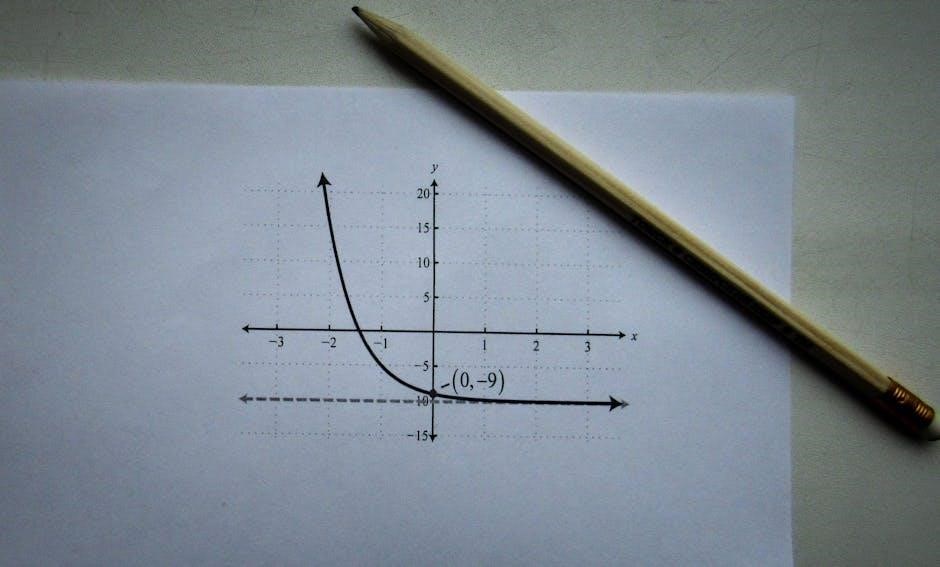
Quadratic functions are fundamental to understanding projectile motion, and worksheets – often available as PDF downloads – frequently feature these examples. These problems model the path of objects launched into the air, like balls or rockets.
The height of the projectile over time is typically represented by a quadratic equation. NCERT-based materials, such as those from Jagran Josh for Class 11 Maths, provide practice in determining maximum height, range, and flight time.
Worksheet questions often involve given initial velocities and launch angles. Students must then use the quadratic equation to predict the object’s trajectory. Answer keys are crucial for verifying solutions and understanding the relationship between the equation’s coefficients and the physical parameters of the motion. These examples solidify the link between algebra and physics.
Optimization Problems
Quadratic functions are powerfully applied to optimization problems, a common feature in worksheets – often provided as PDF resources. These problems seek to find the maximum or minimum value of a quantity, represented by a quadratic equation.
Examples include maximizing the area of a rectangular enclosure with a fixed perimeter, or minimizing the cost of materials for a specific volume. NCERT-based worksheets, like those offered by Jagran Josh for Class 11 Maths, provide structured practice in these scenarios.
Students learn to identify the vertex of the parabola, as this point represents either the maximum or minimum value. Answer keys allow for self-assessment and reinforce the connection between the algebraic solution and the real-world context. Mastering these problems builds critical thinking and problem-solving skills.
Completing the Square
Completing the square is a crucial technique for rewriting quadratic functions into vertex form, a key skill emphasized in worksheets and PDF resources. This method involves manipulating the quadratic expression to create a perfect square trinomial.
NCERT-based worksheets, such as those available from Jagran Josh for Class 11 Maths, offer ample practice in this algebraic manipulation. Students learn to isolate the constant term and add/subtract appropriate values to achieve the desired form.
This process not only aids in finding the vertex of the parabola but also lays the foundation for solving quadratic equations and understanding quadratic function transformations. Detailed answer keys are provided to verify solutions and reinforce understanding of each step involved in completing the square.
Solving Quadratic Equations by Factoring

Factoring quadratic equations is a fundamental skill practiced extensively through worksheets and PDF resources designed for Class 11 Maths, aligning with NCERT standards. This method involves breaking down the quadratic expression into a product of linear factors.
Jagran Josh provides materials that guide students through identifying common factors, applying various factoring techniques (like difference of squares or trinomial factoring), and setting each factor equal to zero to find the roots.
Mastering this technique is essential for determining the x-intercepts of the parabola and understanding the solutions to real-world problems modeled by quadratic equations. Comprehensive answer keys accompany these worksheets, enabling students to check their work and solidify their understanding of the factoring process.
Worksheet Examples & Answer Keys (PDF Focus)
Jagran Josh delivers quadratic functions worksheets in easily accessible PDF format, specifically tailored for Class 11 Maths students following the NCERT curriculum. These worksheets present a diverse range of problems, from identifying coefficients to graphing parabolas and solving equations.
Examples include finding the vertex, determining the axis of symmetry, calculating intercepts, and applying the quadratic formula. Crucially, each worksheet is accompanied by a detailed answer key. This allows for self-assessment and independent learning.
The PDF format ensures portability and easy printing, making practice convenient. Students can work through problems at their own pace, verify their solutions, and pinpoint areas needing further review. These resources emphasize consistent practice for mastery.
Resources for Additional Practice
Beyond the NCERT-based worksheets offered by Jagran Josh in convenient PDF format, numerous online resources bolster quadratic functions practice for Class 11 Maths students. Websites like Khan Academy provide comprehensive video lessons and interactive exercises, reinforcing core concepts.

Many educational platforms offer tailored practice sets, allowing students to focus on specific skills – such as factoring, completing the square, or utilizing the quadratic formula. These platforms often provide immediate feedback and step-by-step solutions.
Textbook companion websites frequently include additional problems and quizzes. Furthermore, exploring past Class 11 exam papers exposes students to the types of questions commonly asked, enhancing exam preparedness. Consistent engagement with these varied resources is key to achieving proficiency.